Deworming Tablets for Dogs in India: 2026 Vet-Reviewed Guide
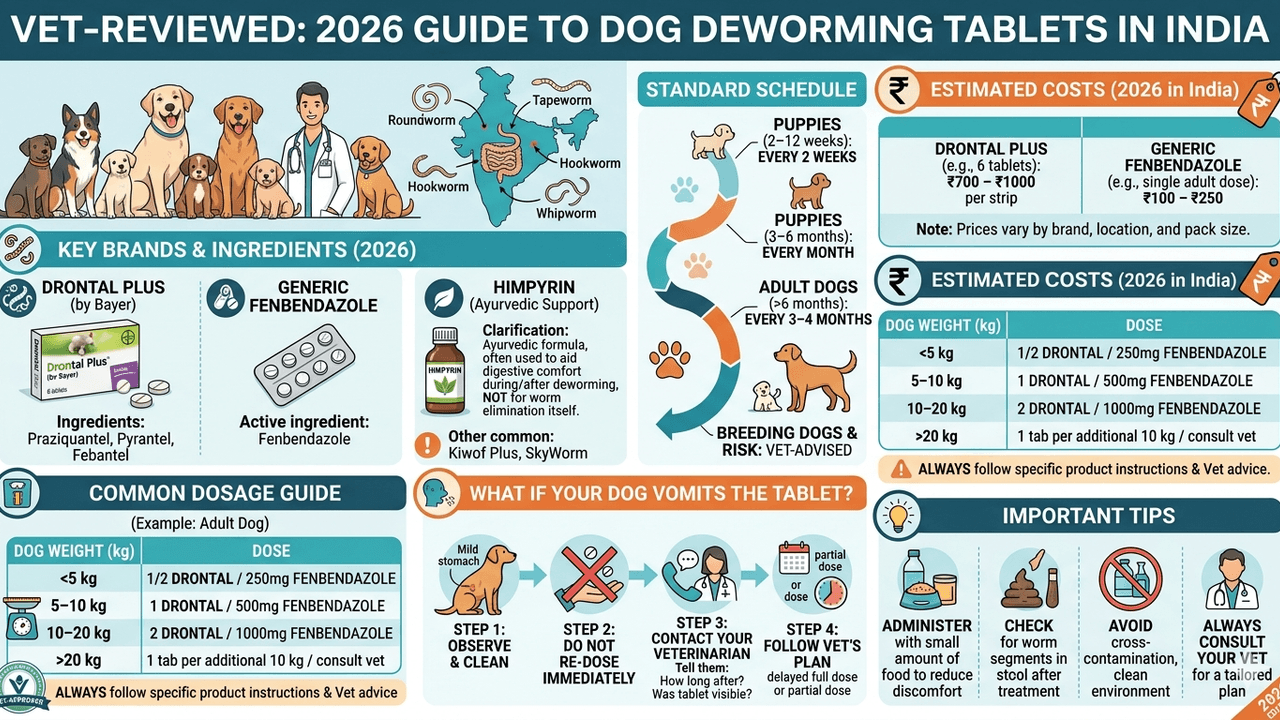
Deworming tablets for dogs in India typically use fenbendazole, praziquantel, pyrantel pamoate or febantel — commonly sold as Drontal Plus, Bayer Vermizyme, Himpyrin, Panacur, Endogard and indigenous brands. Cost ₹100–₹600 per dose depending on product and dog weight. Standard schedule — every 2 weeks 2–12 weeks, monthly to 6 months, then every 3 months in adult dogs (more in high-risk environments). Always dose by vet guidance, not by improvising.
Why this matters in India
Deworming is the most under-discussed clinical decision in Indian dog ownership — universally needed, frequently mis-timed, often improvised. Indian dogs face higher worm exposure than most countries because of free-ranging stray populations, fly load, monsoon-driven soil contamination and frequent outdoor access. This guide explains the actual molecules, the schedule, the dose framework and what to do when things go wrong. All specific dose decisions belong with your vet — this guide explains the framework, not mg/kg.
Why do dogs need deworming in India?
Common intestinal parasites in Indian dogs:
- Roundworms (Toxocara canis, Toxascaris leonina) — most common in puppies; can be passed from mother to litter; zoonotic to humans (visceral larva migrans)
- Hookworms (Ancylostoma caninum) — soil-acquired; zoonotic (cutaneous larva migrans)
- Whipworms (Trichuris vulpis) — soil-acquired, chronic; harder to clear
- Tapeworms (Dipylidium caninum, Echinococcus, Taenia) — flea-transmitted or from raw meat
- Heartworms (Dirofilaria immitis) — mosquito-transmitted; emerging concern in India
- Giardia, Coccidia — protozoal, often need different drugs than standard dewormers
Untreated intestinal worms cause weight loss, anaemia, diarrhoea, poor coat, slow growth in puppies, and in severe cases obstruction and death. Several Indian dog worms are zoonotic — human family members can be infected from a wormy dog through soil, faeces or contaminated hands.
Common deworming tablets available in India
Brand / Molecule | Coverage | Typical use | Cost per dose (₹) |
|---|---|---|---|
Drontal Plus (Pfizer) — praziquantel + pyrantel pamoate + febantel | Round, hook, whip, tape | Adult dogs broad-spectrum | 100–300 |
Bayer Vermizyme / Vermipet — pyrantel + praziquantel | Round, hook, tape | Adult dogs | 100–250 |
Himpyrin (Himalaya) — pyrantel pamoate | Round, hook | Puppies and adults | 80–200 |
Panacur (MSD) — fenbendazole | Round, hook, whip, Giardia, some tape | Puppies and adults; 3-day course | 150–500 |
Fenbendazole indigenous (various) | Same as Panacur | Lower-cost alternative | 80–250 |
Endogard (Virbac) — praziquantel + pyrantel + febantel | Round, hook, whip, tape | Broad-spectrum | 150–400 |
Milpro (Virbac) — milbemycin + praziquantel | Round, hook, whip, tape, plus heartworm prevention | Broad + heartworm | 250–600 |
Pyrantel pamoate generic | Round, hook | Young puppies (from 2 weeks) | 50–150 |
Albendazole generic | Broad spectrum | Lower-cost option | 50–200 |
Brand availability varies by region. Your vet picks based on your dog's age, weight, exposure history and the specific parasite profile.
Deworming schedule by age
This is the WSAVA / CAPC-aligned schedule used in most Indian veterinary practice. Individual cases adjust.
Age | Frequency |
|---|---|
2, 4, 6, 8 weeks | Deworming dose every 2 weeks |
8 weeks–6 months | Monthly |
6 months–1 year | Every 2–3 months |
1 year + (adult dogs) | Every 3 months (more frequent if high-risk exposure) |
High-risk adults (working dogs, multi-pet households, exposure to strays) | Monthly to every 2 months |
Pregnant females | Late pregnancy + during lactation; only specific products |
Senior dogs with kidney / liver issues | Vet-tailored protocol |
Pair with the puppy vaccination schedule India for the full first-year veterinary plan.
How are dewormers dosed?
Dewormers are dosed by body weight in kilograms. Each product has a specific mg/kg recommendation that varies by molecule.
Specific mg/kg dosing belongs with your vet — over-dosing risks toxicity (particularly in sighthound breeds and certain genetic profiles), under-dosing fails to clear worms.
The framework you should know:
- Weigh the dog at the visit (every visit; weight changes)
- Confirm the product the vet has prescribed
- Confirm the dose count per administration
- Confirm whether it's a single dose or a multi-day course (Panacur / fenbendazole is typically 3 consecutive days)
- Confirm with food or empty stomach instructions
- Note when to repeat
What to do if your dog vomits the dewormer
- Within 1 hour of dosing — call the vet; usually re-dosing is advised
- Between 1–4 hours — vet may advise re-dose, or wait and re-dose in 2 weeks
- More than 4 hours — the medication is likely absorbed; observe and report
- Persistent vomiting — see dog vomiting white foam and call the vet
Do not re-dose on your own. Some dewormers have narrow safety margins; doubling up has consequences.
Side effects to expect and to worry about
Mild and expected:
- Mild lethargy for 24 hours
- Soft stool or mild diarrhoea
- Visible worms in stool 24–72 hours after dosing (this is the medication working, not a failure)
Call the vet if:
- Repeated vomiting beyond the first few hours
- Severe lethargy or collapse
- Tremors, seizures, ataxia (incoordination)
- Severe diarrhoea or bloody stool
- Facial swelling or hives
Severe reactions are rare but possible, particularly in sighthounds (Collies, Australian Shepherds, related breeds) with MDR1 gene variants — vets often choose specific dewormers for these dogs.
Heartworm prevention in India
Heartworm (Dirofilaria immitis) is a mosquito-transmitted worm that lives in the heart and pulmonary arteries. It is an emerging concern in India, particularly in tropical and coastal regions.
Prevention options:
- Milbemycin (Milpro) — monthly oral; broad-spectrum
- Ivermectin — monthly; avoid in MDR1-positive breeds without testing
- Moxidectin — injectable or topical; longer-acting
Annual heartworm testing before re-starting preventive is the standard. If your dog has been off prevention for any extended period, test before re-starting — giving heartworm preventive to a dog with adult worms can be dangerous.
Deworming for puppies — special considerations
Puppies are essentially always wormy:
- Pyrantel pamoate from 2 weeks — safe and effective for roundworms and hookworms in young puppies
- Combination products from 6–8 weeks — once the puppy is large enough
- Fenbendazole (Panacur) — useful from later, particularly for Giardia
- Frequency every 2 weeks until 12 weeks; then monthly
See stray puppy care in India for the broader rescue-puppy framework.
Deworming for adult dogs in India
Most adult dogs benefit from quarterly deworming with a broad-spectrum product (Drontal Plus, Endogard, etc.). High-risk adults (frequent stray contact, working dogs, multi-pet households, regular outdoor scavenging) need monthly to every-2-months.
Indoor-only urban dogs may be tempted to skip — do not. Worms enter through flea ingestion (Dipylidium), through human shoes (Toxocara eggs in dust), through raw food and through any soil contact. Indoor-only dogs are reduced-risk, not zero-risk.
Tick and flea prevention vs deworming — different things
Deworming tablets typically do not cover ticks and fleas (Bravecto, NexGard, Frontline, Simparica are the tick-flea preventives). Deworming covers internal parasites; tick-flea preventives cover external. Most pets need both. See tick fever in dogs.
Cost of deworming in India (2026)
Cost line | Range (₹) |
|---|---|
Single broad-spectrum tablet (1 dose) | 80–600 |
Fenbendazole 3-day course | 150–800 |
Adult dog annual deworming cost | 400–2,500 (4 quarterly doses) |
Puppy first-year deworming cost | 800–3,500 |
Vet consultation per visit | 400–1,200 metros |
Indian veterinary practice typically dispenses dewormers at consultation cost + small dispensing margin. Some Indian metro clinics also stock at near-pharmacy pricing.
What about over-the-counter deworming?
Many Indian pharmacies sell dewormers OTC, and many owners self-dose between vet visits. Practical advice:
- Within a vet-prescribed protocol — fine; the vet has already determined the right product and dose
- Outside vet guidance — risky for breed-specific contraindications (MDR1) and for getting the molecule right for the worm profile
- First-ever deworming — vet visit; the vet should examine and prescribe
- Persistent worms despite dosing — vet visit to identify the specific parasite via stool examination
Stool sample testing
A faecal examination at the vet identifies the specific parasites present and confirms whether the dewormer is working. Indicated for:
- Persistent diarrhoea despite recent deworming
- Visible worms despite recent deworming
- Pre-travel testing
- Annual wellness check
- New rescued dogs
Cost ₹400–₹1,500 in Indian metros.
When to see a vet
- Before any first-time deworming — vet consultation
- Same-day vet visit for vomiting, severe diarrhoea, lethargy or weakness after dosing
- Annual wellness with stool examination
- Suspected heartworm exposure — testing before any heartworm preventive
- Pregnant or lactating females — specialised protocol
FAQ
Kutte ko worm ki dawai kab deni chahiye?
Puppies ke liye 2, 4, 6, 8 hafte par, phir monthly 6 mahine tak, phir har 3 mahine. Adult dogs ke liye every 3 months (high-risk exposure mein monthly se 2 monthly). Brands — Drontal Plus, Bayer Vermizyme, Himpyrin, Panacur (fenbendazole), Endogard, Milpro. Dose dog ke weight pe depend karta hai aur vet decide karta hai. Pehli baar deworming se pehle vet visit zaroori hai.
How often should I deworm my dog?
Adult dogs — every 3 months for low-risk indoor urban dogs, monthly to every 2 months for high-risk (working, frequent stray contact, multi-pet). Puppies — every 2 weeks 2–12 weeks, monthly to 6 months. Specific schedule from your vet based on lifestyle.
What is the best dewormer for dogs in India?
For broad-spectrum adult deworming — Drontal Plus and Endogard are widely-used reliable choices. For puppies and Giardia — fenbendazole (Panacur). For heartworm-prone areas — Milpro adds heartworm prevention to broad spectrum. Your vet picks based on age, weight, exposure and specific parasites.
How much does deworming cost in India?
Single broad-spectrum tablet ₹80–₹600 depending on brand and dog size. Adult annual cost ₹400–₹2,500 for quarterly dosing. Puppy first-year cost ₹800–₹3,500. Vet consultation typically ₹400–₹1,200 per visit.
What if my dog vomits the dewormer?
Within 1 hour of dosing — call the vet; re-dose typically advised. 1–4 hours — vet may advise wait-and-re-dose. More than 4 hours — likely absorbed; observe. Do not re-dose on your own; some dewormers have narrow safety margins.
Are dewormers safe for puppies?
Yes — pyrantel pamoate is safe from 2 weeks; combination products from 6–8 weeks. Severe reactions are rare. Mild lethargy and soft stool for 24 hours are expected. Persistent vomiting, severe diarrhoea, tremors or collapse warrant a vet visit.
Can humans get worms from dogs?
Yes — several common Indian dog worms are zoonotic. Toxocara (roundworm) eggs in soil can cause visceral larva migrans in humans. Hookworm larvae can cause cutaneous larva migrans. Hand-washing after handling soil, faeces or the dog's bedding, and keeping the dog on a regular deworming schedule are the practical protections. Children are at higher risk.
Sources
- WSAVA — global parasite control guidelines.
- CAPC (Companion Animal Parasite Council) — international parasite recommendations.
- MSD Veterinary Manual — anthelmintic drugs reference.
- Manufacturer datasheets (Pfizer, Bayer, MSD, Virbac, Himalaya).
A note from Critzo (please read): This article is general educational information written and reviewed by qualified veterinary professionals for Indian pet parents. It is not a substitute for an in-person consultation with your own veterinarian, who knows your pet, their history, and their current clinical state. Pets are individuals — breed, age, weight, pre-existing conditions, medications, and local disease patterns all change what is safe and what is not. Do not start, stop, or change any medication, vaccination schedule, diet, or treatment based on what you read here without first speaking to a registered veterinary practitioner. If your pet is showing emergency signs — collapse, seizure, severe bleeding, suspected poisoning, breathing difficulty, bloated abdomen, repeated vomiting or no urination for more than 12 hours — stop reading and go to the nearest 24-hour veterinary hospital immediately. You follow any guidance from this article at your own risk and at your pet's risk. Critzo, its authors, and its reviewers accept no liability for outcomes arising from decisions made without veterinary supervision.